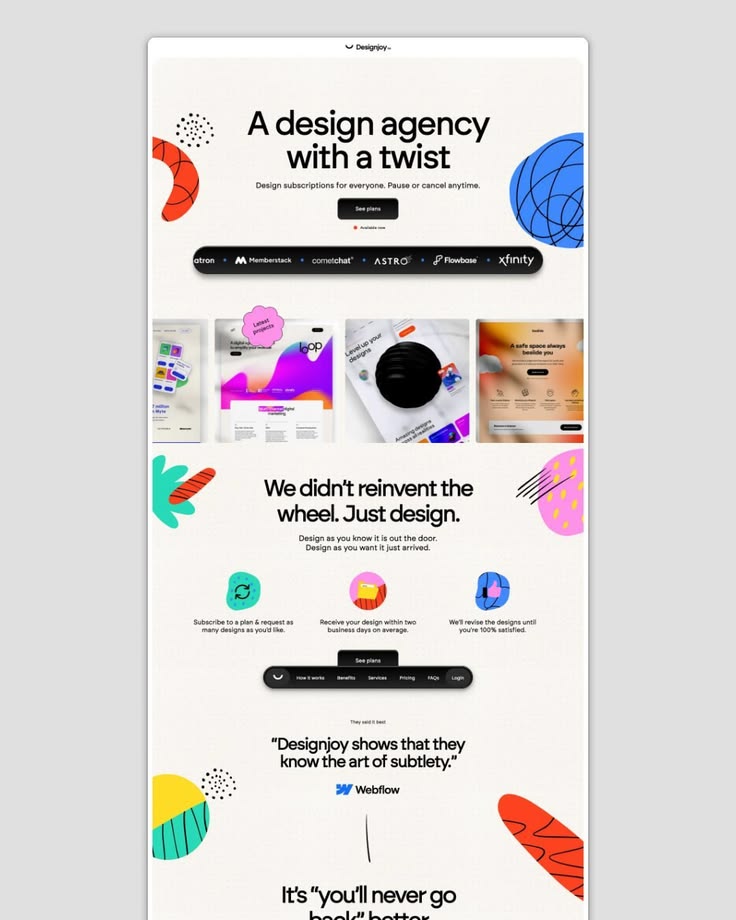
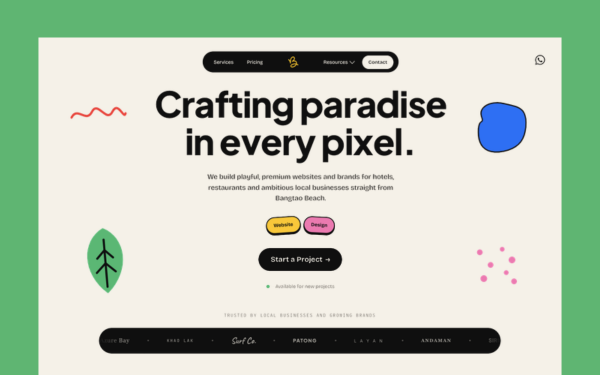
Every week we talk to a new client who's been told that Webflow, Squarespace, or Elementor is "just as good as custom-coded." Sometimes this is sincere advice. Sometimes it's a sales pitch. Either way, it's worth unpacking — because after building dozens of sites for hospitality businesses on Phuket and beyond, we've seen the real difference firsthand.
This isn't a rant against page builders. They have their place. But if you're running a serious hotel, restaurant, or local business that cares about performance, design quality, and long-term growth — you deserve to understand the trade-offs before you commit.
The weight problem
Every page builder adds a layer between your design and the browser. Webflow generates CSS that covers every possible scenario the editor might need. Elementor loads a runtime framework before it renders a single pixel. Squarespace bundles hundreds of kilobytes of JavaScript regardless of whether your page uses any of it.
A hand-coded site ships exactly what the page needs. Nothing more. A typical landing page we build at Bangtao Studio comes in under 100kb total — including fonts and images optimised to the right resolution. A comparable Elementor build is typically 8–15× heavier.
"Every 100ms of load time costs approximately 1% of revenue." — Google Commerce data, 2023
For hotels, this is a real number. A 2-second delay on a booking page during peak season isn't abstract — it's reservations walking out the door.
Google sees everything
Core Web Vitals — Google's performance scoring system — rewards sites that load fast, respond fast, and shift their layout as little as possible during load. Page builders consistently struggle with all three metrics because their architecture was designed for visual editing convenience, not browser rendering efficiency.
The sites we build for clients regularly score 95–100 on Google PageSpeed for mobile. Page builder alternatives from the same clients' previous vendors typically ranged from 40–65.
That's not a small gap. It directly affects organic search ranking — especially in competitive local search like "best restaurant Phuket" or "boutique hotel Bangtao beach."
Design without constraints
Every page builder has a visual language. Webflow's grid system. Squarespace's block model. Elementor's widget library. These tools were designed to empower non-designers to build decent-looking pages — which is a worthy goal. But it also means that truly distinctive design requires fighting the tool rather than using it.
When we design a site from scratch in Figma and implement it in clean HTML and CSS, there are no constraints on layout, animation, interaction, or typography beyond what the browser supports. The design is the code. The code is the design. Nothing is lost in translation.
Maintenance and longevity
Page builders create dependency. When the platform changes its pricing, discontinues a plugin, or breaks in a browser update — you're waiting on them to fix it. When we ship a site, the code is yours. It doesn't depend on a third-party subscription to keep working.
We've taken over multiple Elementor sites from clients who needed critical updates and found the environment had drifted so far from a clean state that rebuilding was faster than fixing. Hand-coded sites, maintained with care, tend to age cleanly — because they were written to spec, not generated.
When builders make sense
All that said — page builders are the right tool for certain situations. If you need to manage your own content daily without developer support, a CMS like Webflow or Squarespace might genuinely serve you better. If you're testing a new idea quickly before investing in a full build, a builder can be faster to prototype with.
The mistake is treating them as equal to custom code for a production website you'll depend on for years. They're not. And most clients we work with, once they've seen the difference in practice, never go back.
The decision
If performance, design quality, SEO, and ownership matter to you — hand-coded is the right choice. If you need a visual editor and fast self-sufficiency — a builder might work. Most of our clients land in the first camp, which is why we do what we do.
Have questions about your specific situation? We're happy to give you an honest opinion — even if the answer is "a builder is fine for you." Drop us a message.